
Untitled
Heidegger argued that technology is not merely a tool in human hands, but a mirror that shapes how we perceive and inhabit the world. Today, as artificial intelligence begins to intervene in how we learn, create, and make decisions, a fundamental question echoes: is AI opening new paths for us, or quietly constructing an invisible cage that confines human freedom and thought?
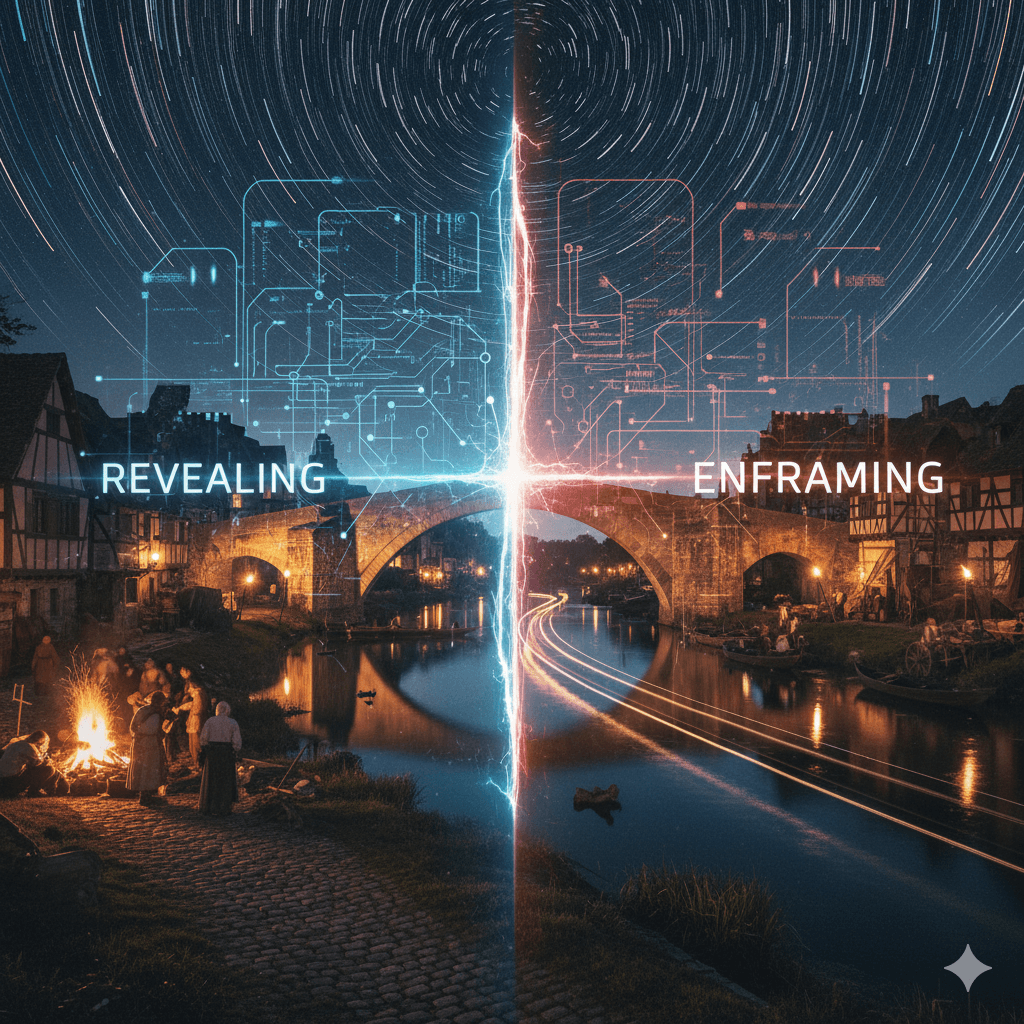
"Technology as a Mode of Revealing": when technology shapes our freedom

Martin Heidegger (1889–1976), a German philosopher, is one of the most influential voices of the 20th century on the nature of being. His analyses of modern technology, which are the focus of this article, are considered ahead of their time and remain highly relevant today. His career is also marked by deep political controversies.
1. When a bridge reveals an entire river landscape
The philosopher Martin Heidegger once evoked a famous image: building a bridge is not merely about connecting two banks; rather, the bridge itself brings forth the river in its full meaning, its shores, its flow, its upstream and downstream, the pathways that cross it, and the rhythms of human life intertwined with it. Through the bridge, the river is no longer just a physical entity, but becomes a "region" where the world reveals itself to us. Heidegger’s point is that technology, at its core, is never merely a tool in human hands; it is a mode of revealing, a way in which things, spaces, and even we ourselves come into meaningful presence. Therefore, the fundamental philosophical question is not simply "what do we use technology for?", but rather: "how does technology shape the way we see and dwell in the world?"
In the age of AI, this question becomes more urgent than ever. If a bridge is a visible material structure that opens a landscape for us to traverse and inhabit, then artificial intelligence is an invisible cognitive structure: it does not appear as a physical object, yet it silently arranges and determines what counts as salient, what is considered reasonable, and what is deemed "just plausible enough" to believe. AI does not transport our bodies across space like a bridge, but it transports our attention, beliefs, and possibilities for action from one context to another. It organizes the order of what appears before us: opening certain possibilities while quietly closing others.
For this reason, AI does not merely raise technical questions; it touches deeper philosophical layers concerning truth, freedom, and how humans inhabit the world. Where AI intervenes, the question is no longer "how does it help us?", but "how has it reshaped the way we see, think, and live?". And within this revealing lies the risk of an invisible enframing, where both the world and human beings are reduced to data points within a probabilistic graph.
2. Technology as "revealing" and the danger of "enframing"
Heidegger distinguishes between two modes of revealing:
- Poiēsis: a bringing-forth, like a craftsman who does not create from nothing, but allows a form already latent in the material to emerge.
- Gestell (enframing): a forcing mode of revealing that gathers everything as a standing-reserve, compelling things to appear only as resources to be exploited, mobilized, and optimized.
When enframing dominates, the entire world appears as a vast reservoir of resources. A forest becomes "timber stock," a river becomes "hydroelectric capacity." Even human beings are reduced to "labor resources" or, in contemporary terms, to "behavioral data streams" that can be predicted and manipulated. This is what Heidegger calls Bestand—the transformation of beings into a reserve always available for extraction. The ethical issue lies within the structure of perception itself: we only see things as what can be exploited.
In the context of AI, this image becomes strikingly concrete. AI—with sensors, data, and models—works together to transform not only objects but also relationships, emotions, habits, and desires into measurable, storable, and predictable data. This process of datafication is an expression of Gestell at exponential scale. Not only objects, but emotions, relationships, and habits are datafied: everything becomes a "computable unit," flowing into predictive machinery. We risk seeing ourselves as probability distributions, and others as feature vectors.
3. What is freedom in an algorithmically constructed space?
In philosophical traditions, "freedom" is often understood in at least three layers:
- Freedom of choice (liberty): having multiple options to choose from.
- Freedom of initiation (Arendt): the capacity to begin something new within a shared space.
- Reflective autonomy (Kant): the ability to deliberate and set rules for one’s own actions.
AI is often marketed as expanding choice: more search results, more recommendations. But more options do not necessarily mean more freedom. When recommendations are personalized, the space of possibilities may be narrowed to what the model predicts we "will like." The freedom to initiate weakens if unexpected possibilities are optimized away, and reflective autonomy fades when rules of action are implicitly delegated to algorithms.
In other words, freedom is not only about "what we choose", but about "what we are able to see" and what we can initiate within a world already arranged by models.
4. Truth between "plausible enough" and "essentially true"
Philosophy has long understood "truth" in multiple ways: correspondence, coherence, pragmatism. Generative AI optimizes for probability and surface plausibility—the kind of answer that is just convincing enough to believe. This is useful, but it risks eroding our capacity for critical reflection.
The crisis of truth in the age of AI is not only that models occasionally hallucinate and produce false statements. The deeper danger lies in the fact that we gradually become accustomed to accepting surface plausibility as a full substitute for truth. To preserve what is "essentially true," we need habits of critique. We must ask models: "why?", "based on what sources?", and most importantly, we must accept cognitive friction—moments of pause, confusion, and doubt—instead of passively accepting instant answers.
5. The self as an ongoing interpretive project
Existential philosophy emphasizes that human essence is not pre-given; we are beings who construct and interpret ourselves through actions and choices. We are "condemned to be free" and responsible for the project called the self.
AI intervenes in this process in subtle ways. It learns from our digital traces, builds a model of us, and reflects that model back through recommendations and predictions. The risk is a feedback loop: we gradually adjust our behavior to match that digital shadow, turning the self into an optimized replica of past data. Deviations, inner contradictions, and spontaneous impulses—sources of growth and creativity—risk being smoothed out in the pursuit of consistency.
Buddhist philosophy offers a valuable complementary perspective through the principle of non-self (anatta). The "self" is not a fixed entity, but a composite of conditions, a constantly changing flow. Recognizing this allows a dual stance: caution (do not reify the self that AI describes) and freedom (dare to step beyond its predictions). In a deeper sense, freedom may be the ability not to coincide with any model of oneself.
6. The politics of architecture: who defines the objective?
Every AI system has an objective function—explicit or implicit. Maximize watch time? Maximize satisfaction? Minimize cost? These objectives are value judgments. The politics of AI lies at the architectural level: who defines the objective, and who is accountable for its consequences?
From an ethical perspective, the chain of responsibility must be clear:
- Those who define the objective: deciding what counts as "good."
- Those who design the data: determining what is "representative" of reality.
- Those who build the interface: deciding what is visible and what is hidden.
- Those who manage externalities: ensuring accountability when harm occurs.
If this chain is obscured, responsibility is displaced onto "the algorithm" or "the model," as if an abstract entity could bear moral responsibility—a burden that only humans can and must carry.
7. From "enframing" to "dwelling": ethics of design in the age of AI
How can we return AI technology to the spirit of poiēsis rather than Gestell? Consider a set of design virtues:
- Goal-oriented interpretability: Rather than explaining billions of parameters, clearly explain which values were chosen and what trade-offs were made in the objective.
- The dignity of refusal: Systems should refuse to answer when uncertain, rather than fabricate plausible responses.
- Intentional cognitive friction: introduce moments of pause—"stop, look, reflect"—in consequential decisions.
- Data minimization: collect only what is necessary, recognizing the ethical cost of datafication.
- Capacity for disengagement: provide "slow mode," "source mode," and "verification mode," creating exits from algorithmic paths.
- Diversification of possibilities: intentionally surface low-probability but meaningful options to preserve surprise.
- Transparent responsibility chains: clearly indicate who is responsible at each stage; responsibility must not hide behind "AI says."
These virtues may not improve benchmark scores, but they make humans more free within AI-mediated environments.
8. Opening paths for thinking, not shortcuts
Rather than treating AI as a machine for solving problems as quickly as possible, we should use it as a tool to expand human capability. A good AI system should not turn life into an optimization problem, but create space for deeper thinking, creativity, and responsible decision-making.
Consider concrete examples:
- In education: Instead of acting as an "answer machine," AI should function as a "learning companion," asking questions like "Why did you think that?" or "Have you tried another approach?"
- In art: Rather than producing finished outputs, AI can serve as a source of unexpected inspiration—provoking new directions.
- In governance and decision-making: Instead of presenting a single "optimal" answer, AI should clarify trade-offs: "If we choose A, who benefits and who is harmed? What about B?"
This approach treats AI not as an all-powerful solution, but as a tool for asking better questions and understanding responsibility.
9. Conclusion: preserving the capacity for wonder
Ultimately, what makes us human is not computation, but our capacity for wonder—a capacity that optimization systems often erode. Philosophy reminds us that perception is never purely objective; every act of seeing already contains selection and judgment.
If technology is the way the world reveals itself, then the central ethical question of our time is: how do we want the world—and ourselves—to be revealed?
Let us learn to design and use AI like building a bridge: to open paths, not to enclose; to reveal richness, not to obscure; to cultivate freedom, not to replace responsibility. In doing so, AI does not make us less human—it demands that we strive to become more fully human.
Further Reading
The Question Concerning Technology (Martin Heidegger)
Heidegger on Technology’s Danger and Promise in the Age of AI (Cambridge University)
Related Articles
Discover more articles related to this topic
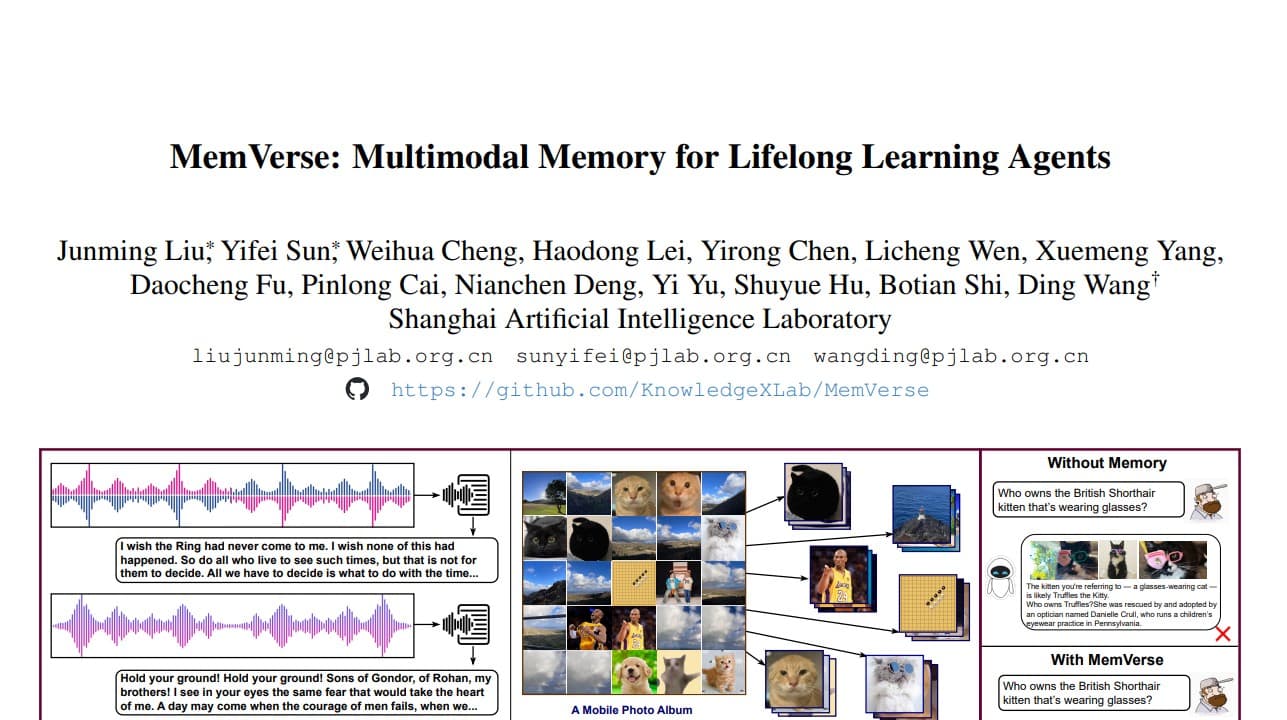
MemVerse: Multimodal Memory và con đường hướng tới Lifelong Learning Agents
Phân tích MemVerse – một framework bộ nhớ đa phương thức cho AI Agents học tập suốt đời, kết hợp Knowledge Graph truy xuất và Parametric Memory để giải quyết bài toán catastrophic forgetting, tối ưu suy luận đa phương thức và tương tác dài hạn.
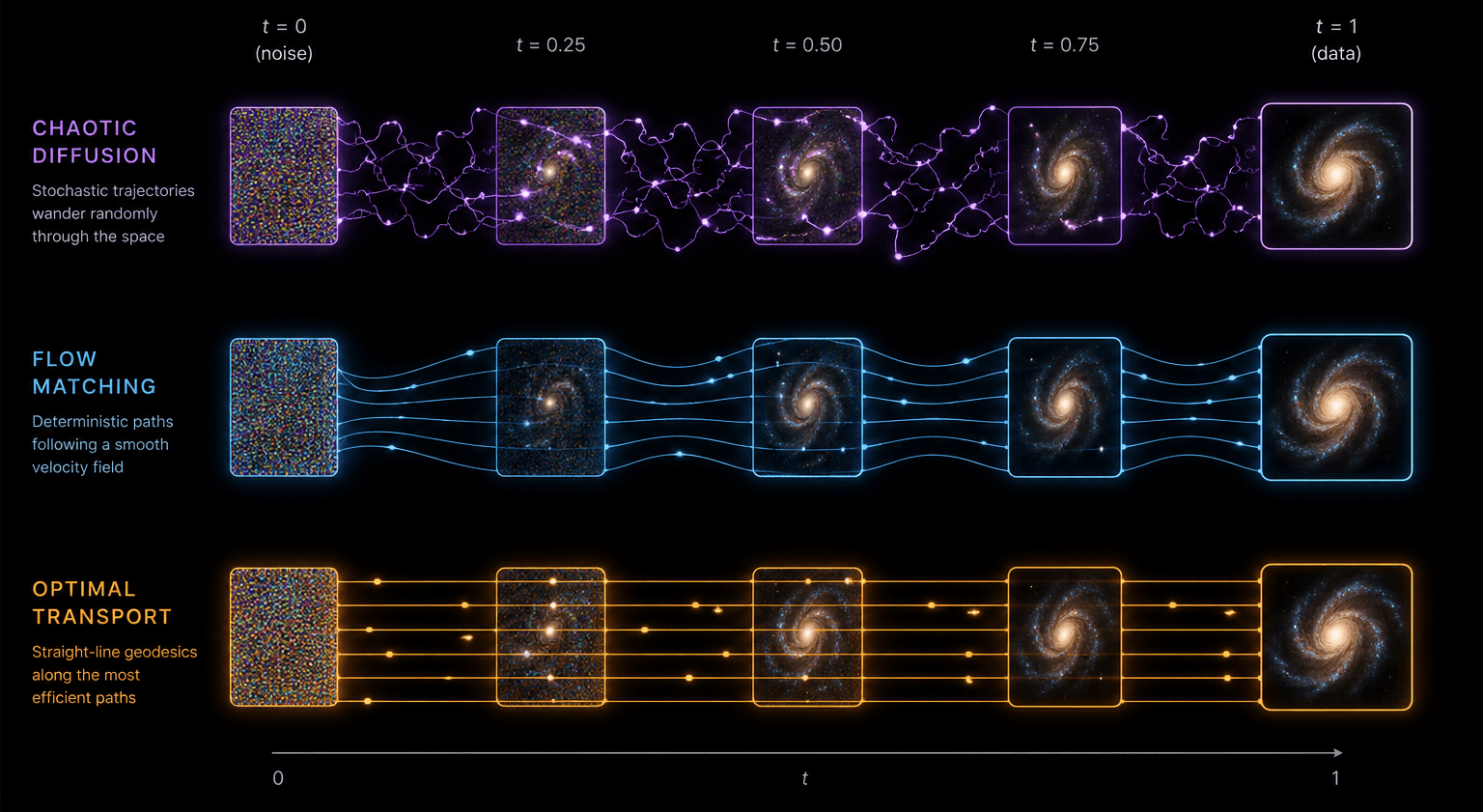
Diffusion vs Flow Matching vs Optimal Transport
Phân tích tổng quan sự khác nhau và điểm tương đồng giữa Diffusion, Flow Matching và Optimal Transport dưới góc nhìn chuyển động của phân phối xác suất, từ hàm mất mát đến quá trình lấy mẫu.
Ngôn Ngữ, Xác Suất và Nhận Thức – phương trình công nghệ trong lịch sử mô hình hóa ngôn ngữ của nhân loại
Khám phá hành trình tiến hóa vĩ đại của mô hình ngôn ngữ, nơi ngôn ngữ, xác suất và nhận thức đan xen trong suốt tiến trình lịch sử công nghệ: từ những mô hình thống kê N-gram giản đơn, đến mạng nơ-ron và RNN, rồi bứt phá với LSTM, Seq2Seq và Attention; từ cuộc cách mạng Transformer mở đường cho BERT, GPT và vô số biến thể, đến kỷ nguyên LLM với khả năng sáng tạo, suy luận, đa phương thức. Đây không chỉ là câu chuyện kỹ thuật, mà còn là bản trường ca triết học về cách máy móc phản chiếu tư duy con người và gợi mở viễn cảnh trí tuệ nhân tạo tổng quát.

Lỗ hổng bảo mật trong Multi-Agent AI: Hiểm nguy từ Prompt Injection
Khám phá cách các cuộc tấn công prompt injection lợi dụng hệ thống multi-agent LLM hiện đại: từ việc tối ưu đường đi theo băng thông, cho đến kỹ thuật permutation invariance giúp vượt qua hàng rào bảo vệ. Bài viết phân tích dựa trên nghiên cứu mới nhất tại ACL 2025 giúp hiểu rõ cách thức kẻ tấn công khai thác cũng như lý do các hệ thống AI phân tán dễ tổn thương.
Discover all 6 articles in our blog